Celebrating the Pilot Project, beginning the Nursery
You are invited to celebrate the Fall Equinox with Arboretum Detroit and Field Temple on Saturday, September 21st, 5-11 pm. There is so much to celebrate, among them is the completion of the first Arboretum project: Treetroit 1. Field Temple and Arb…

You are invited to celebrate the Fall Equinox with Arboretum Detroit and Field Temple on Saturday, September 21st, 5-11 pm. There is so much to celebrate, among them is the completion of the first Arboretum project: Treetroit 1. Field Temple and Arboretum Detroit, 5333 Elmwood and 5300 Elmwood, Detroit, MI 48211

Everyone welcome


The next few months we'll be preparing for, and implementing the Neighborhood Tree Nursery project, supported by a grant from Detroit Future City. You can read more about this project here. We have set regular workdays for the first, second and thir…

The next few months we'll be preparing for, and implementing the Neighborhood Tree Nursery project, supported by a grant from Detroit Future City. You can read more about this project here.

We have set regular workdays for the first, second and third Tuesdays of each month, 6-8pm. This could mean picking up bricks and throwing them into a pile, pruning trees, picking up garbage, measuring distances, brainstorming ideas, and who knows yet what else. This is just the very beginning, since we have finally received the legal go-ahead to get started preparing the land.

Below is the approved design for the Nursery. We are hoping to be planting trees by the end of October."

Nursery Design.png

Before and After - Reflections from Michigan’s Old Growth Forest

Before or After Tree and Sapling.jpg

Kinga stopped to take a picture of the massive nurse log that we climbed over.  It was covered with moss like most things in a mature forest. In the hole of a long gone branch she spied the tiniest of Hemlock saplings.  It was so fresh and tiny that it could have emerged days ago. I came to look and said that it would be a nice picture to use for the next blog and that we could title it “before and after.”  I thought this would capture something about the cyclical nature of life in the forest.  


Kinga said, “which is before and which is after?”  This question more accurately captures the cyclical nature of life in the old growth forest.  Nuances of understanding like this enter the mind like osmosis when we spend ample time in the forest.  There is a completely different sense of time and importance.


Yes, logic tells us that because the tiny Hemlock sapling is green and new, and that the trunk of the old Hemlock is horizontal and moss covered, that the tiny sprout is “after.”  The fallen giant is “before” because it lived likely 300 years before it fell to its current position perhaps 20 years ago. However, this giant, itself, once looked exactly like this little sprout, which in its turn will live a few hundred years before becoming horizontal and nursing the next tiny giant to be.  In short, there is no “before and after.” This is part of why spending time enriches our spirit and soothes the soul lest we think that there is a “before and after” for us. Seeing that a long fallen Cedar still has one green branch or that a mossy nurse log supports more life on the forest floor than it did standing remind me that death is a lie.  There is only the timeless flow of energy, circulating among the many beings here. 


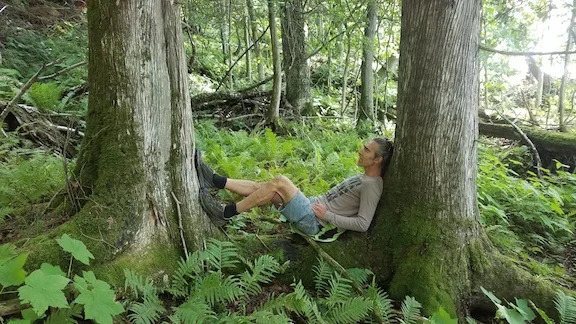
Entering a forest is entering a soup of flux. We step outside of time and into a reality that is not constructed but just is.  Man-made landscapes and contrivances are wrung out of us like mopwater. Concrete and the grid of streets and strip malls, bright lights and sirens, cell phones  and television are wiped from the mind like ink from the whiteboard. Here we see with the whole self. We lose our “selves,” and breathe in reciprocity with the trees, back and forth connecting right at the source.  Enter tree time.


We are so fortunate to have a place like this in Michigan.  Although it is barely in Michigan; did you know you could drive for 12 hours and still be in Michigan?  Yes the Porcupine Mountains State Park is at the far western edge of the upper peninsula. Don’t let the drive scare you off. It’s worth it every time.  The park is about 60,000 acres of forest, half of which is old growth. There are about 100 miles of trails to hike, and 23 miles of wild Lake Superior shore.  And the trees just keep getting older, and younger.  

cedar cradle.jpg
old growth.jpg
Long Road to a (Legal) Tree Nursery

So, it seems that having a tree nursery in the city of Detroit is actually illegal. I had no idea that I have been guilty of criminal tree stewardship for about 30 years. Maybe you have too. A tree nursery becomes illegal when you have 9 or more trees growing on your property with the intention of planting them somewhere off your property. I always have dozens of trees growing in pots and little nurseries in my yard. It seems not only logical, but actually environmentally responsible, to take care of the seedlings I find coming up from the mature trees around me. This is one of the motivations for starting a formal tree nursery for our community. Not everyone has the space or the experience to be able to take a tree from an inch tall sprout, to a three-foot whip, to a one inch caliper tree. But we do all have access to these sprouts if we just notice and can identify them as they germinate in our lawns and gardens. Our nursery will be a place for neighbors to bring these little sprouts and saplings to ensure that they are cared for and can become the trees they are destined to be. Most naturally germinating trees in urban and suburban settings are mowed down again and again until they give up and expire. This happens to billions of trees each year. Imagine if we all let these trees grow where they sprout, or placed them in community nurseries. If our project works like I believe it will it could be replicated and become a fixture of the communities of the future, especially here in Detroit, where we have the space to incorporate one on every block.

So, how does one make a legal nursery? Well, it has been a long road with lots of meetings and paperwork, and we are not quite there yet. We need a “Special Land Use” because we are in residential zone and the nursery will constitute an “urban farm.” We are in the process of combining parcels so that the work we do for our “Special Land Use” can apply to a total of six lots. The nursery we are building this fall will be on only three of those lots, but we want the ruling on our special land use to apply to six so that we can expand in the future without having to undertake again this whole process and expense.

We are very close to becoming this required urban farm. After getting to know BSEED- Building, Safety, Engineering, and Environmental Department- very well, along with their ePLAN, eLaps, and ProjectDox, we are at the very last stage. We are scheduled for a “Special Land Use” hearing on August 7th. This is so that anyone within 300 feet of the nursery who has questions, concerns, or objections, can come and be heard. We hope this goes well, and if it does we will break ground on our Arboretum Detroit Tree Bank. The design of the nursery is included here to demonstrate layout of the nursery.

We want the rows oriented on a true north / south axis to add both aesthetic interest and tangible reminder of cardinal directions. This consciousness is very important when planting gardens, trees, and designing buildings. However, the standard grid of the city does not help us understand where the cardinal directions are. This orientation for the nursery will help us educate about these directions and their implications for those who plant the trees that graduate from the nursery. This will also offer a more natural feng shui for entering the nursery. The nursery opens up to the intersection at an angle much softer than a sharp 90 degrees that the grid layout demands; it’s a psychological break from these confines for us and for the trees. The trees are already salty about having to spend years in straight rows. They teach us with the form of their crowns, branches, and roots that something more organic suits them.

We are keeping a few mature trees in the nursery, because they were here first, and they will offer some relief from the full sun that could be too much stress for the young trees. We will also plant some trees into the nursery permanent as permanent fixtures. These will offer a park-like welcoming to the 15 foot set-back as well as offer some shade. The nursery will include a gazebo-type structure at the entrance for gathering, education, and small events. Here we will do seed and perennial exchanges, education, and have lunch with friends.

The trees shown in the drawing are just a starting point. We may choose more and other varieties based on a community feedback survey. It is fun but complicated choosing a couple hundred trees for a nursery. There are many many considerations and many many opinions. I mean, we all kind of have our favorite trees and would love to see more of these. One wants not to have a personal hierarchy of trees, as all trees do their jobs perfectly. There are questions of native and non-native species. Do we want exclusively native trees? Or do we think that trees from other places can be useful in exhibiting differing forms and habits, and getting people excited about trees? Are there trees that we could use more of, and are there trees that are already overrepresented here in Detroit? All these considerations are valuable, and may have to be the subject of a later post.

For now, stay tuned to the corner of Farnsworth and Elmwood. Watch a nursery grow.

Nursery Design 8.5x11.png
Birch
Treetroit 1 is Planted

The trees have landed. Our Earth Day event went swimmingly well. What I mean is that those of us who came were literally swimming as we planted. There was a spring deluge exactly during the hours of our event. So, we really want to thank all those who came out. We met tree lovers from Novi, Madison Heights, Northville, and around our beloved Detroit. It was really cool that people came from far away to support a project that seems so local.

The mud was fierce and slippery and everywhere. Since the trees we planted were so large we had to use the bobcat to lower them into the holes. We had actually already used the bobcat to fork out large holes because the clay was so hard and dense. This allowed us to fill the huge hole with compost and topsoil so that the tree can grow in something more than straight clay.

It was a blast to go out to the nursery and select the trees. What we ended up with was a beautiful mix of trees that were just about 200% over budget. But isn’t it all about the trees? We chose to plant these in trios instead of single specimens. We want their forms and the feel to be amplified as visitors walk among them. We are working toward our goal of creating actual stands of like trees. When we can afford to we will plant them in dozens to give the feel of really being in a grove of, say, Ginkgos, or Birches. We planted three each of Princeton Sentry Ginkgo, Redpoint Red Maple, Paper Birch, Cedar, and Yew. We also planted some understory trees that will add spring excitement. We planted two Kousa Dogwood and two Forest Pansy Redbuds. Oh, and last but not least, on the hill we planted a single Weeping Beech. Did I mention that we imported one-hundred cubic yards of soil to create a hill that sweeps through the middle of the Arb? As a compliment to the living trees we planted 15 boulders. These act as graceful seats and reminders of geologic time. This really brings the earth element into the Arb and deepens the reflection on life in these three time zones: fleeting human time, prolonged tree time, and incomprehensible rock time. The boulders were unearthed from farm fields in the middle of the state. They are making their first local appearance in thousands of years. They were scoured from north of the Great Lakes by glaciers and deposited down here and have likely not seen the light of day since the glaciers receded over 10,000 years ago. May they stand in the sun for the next couple hundred years as the trees grow up in the Arb.

It took three more days to get them all in, but we did it with a core group meeting in the evenings. On Mothers Day Paul and I did the final ground prep and seeded Dutch White Clover. Since then we have made a great friend in the US Fish and Wildlife Service. They are partnering with us to plant 46 varieties of native plants that will benefit the local bees and birds. We seeded about 75% of the Arb with the seed mix they donated.

dropping root ball.jpg
fagus pendula hug.jpg